

There are projects that close in to protect. And there are others that open up to belong to what surrounds them. This residential project imagines a villa suspended on the hills above the city, and it belongs to the second family. The architecture does not defend the interior from the exterior: it opens it, extends it, lets it end where the skyline begins. The boundary between inside and outside is not furnished. It is dissolved.
Four spaces, a single horizon. The kitchen as a threshold, the living room as a belvedere, the walk-in closet as a gallery overlooking the city, the master bathroom as a place to pause at the edge of the landscape. A sequence that shows how high-end Italian minimalism is not decoration removed, but a way of building the relationship with what the project looks upon.
The kitchen: matter in the golden hour
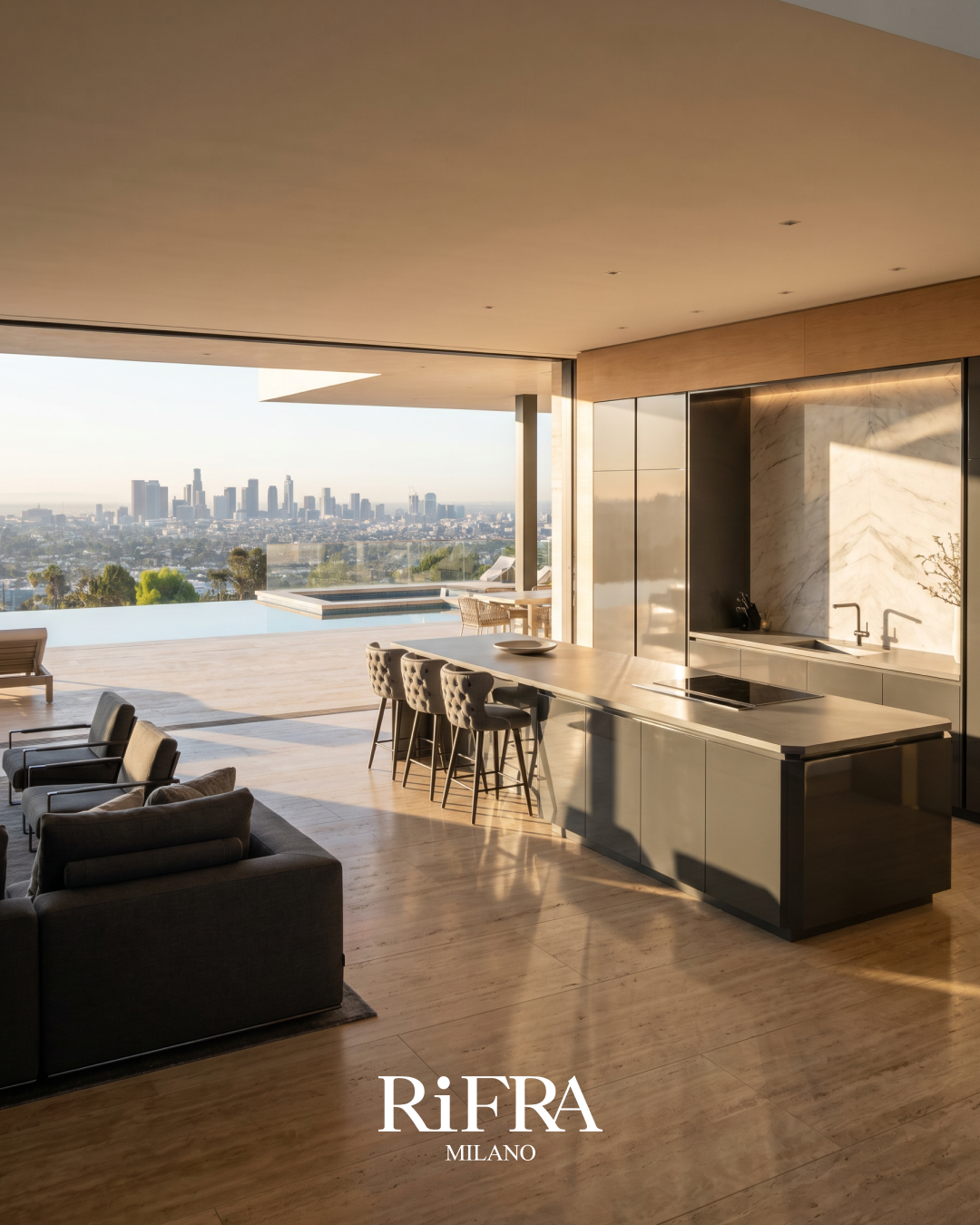
The journey begins with light. Pale natural stone in large formats runs from the floor to the wall, and the kitchen opens entirely onto the terrace, the infinity pool and the skyline. The island is conceived as a monolithic volume in dark metallic lacquer, without handles, cut with pure geometry. Behind it, book-matched slabs of white veined marble draw a chevron vein that becomes the room's only graphic gesture. A single decorative material, left to speak for itself. Everything else is continuous surface, concealed technology, grazing light at sunset.
The living room: a wall that holds the light
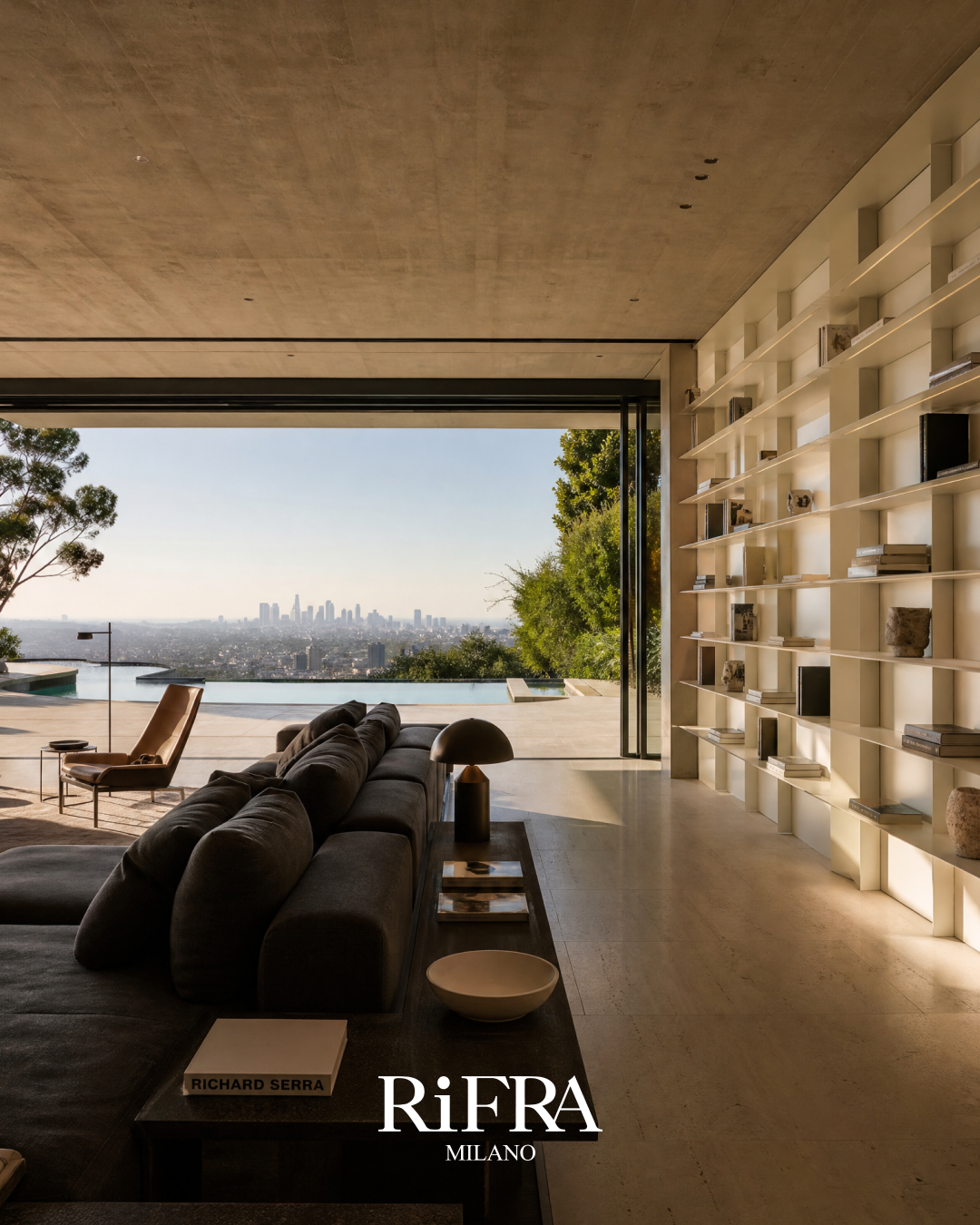
The living room faces the void. The anthracite velvet sofa looks out over the pool and the city, while the backlit stone library-wall holds the books and the silence, the niches carved by light like cuts in the material. The board-formed concrete ceiling — with the grain of the wood imprinted in the formwork — weighs just enough to ground the space. Continuity is not an effect: it is a rule. The material runs through the spaces of the project without interruption.
The walk-in closet: the city behind the glass
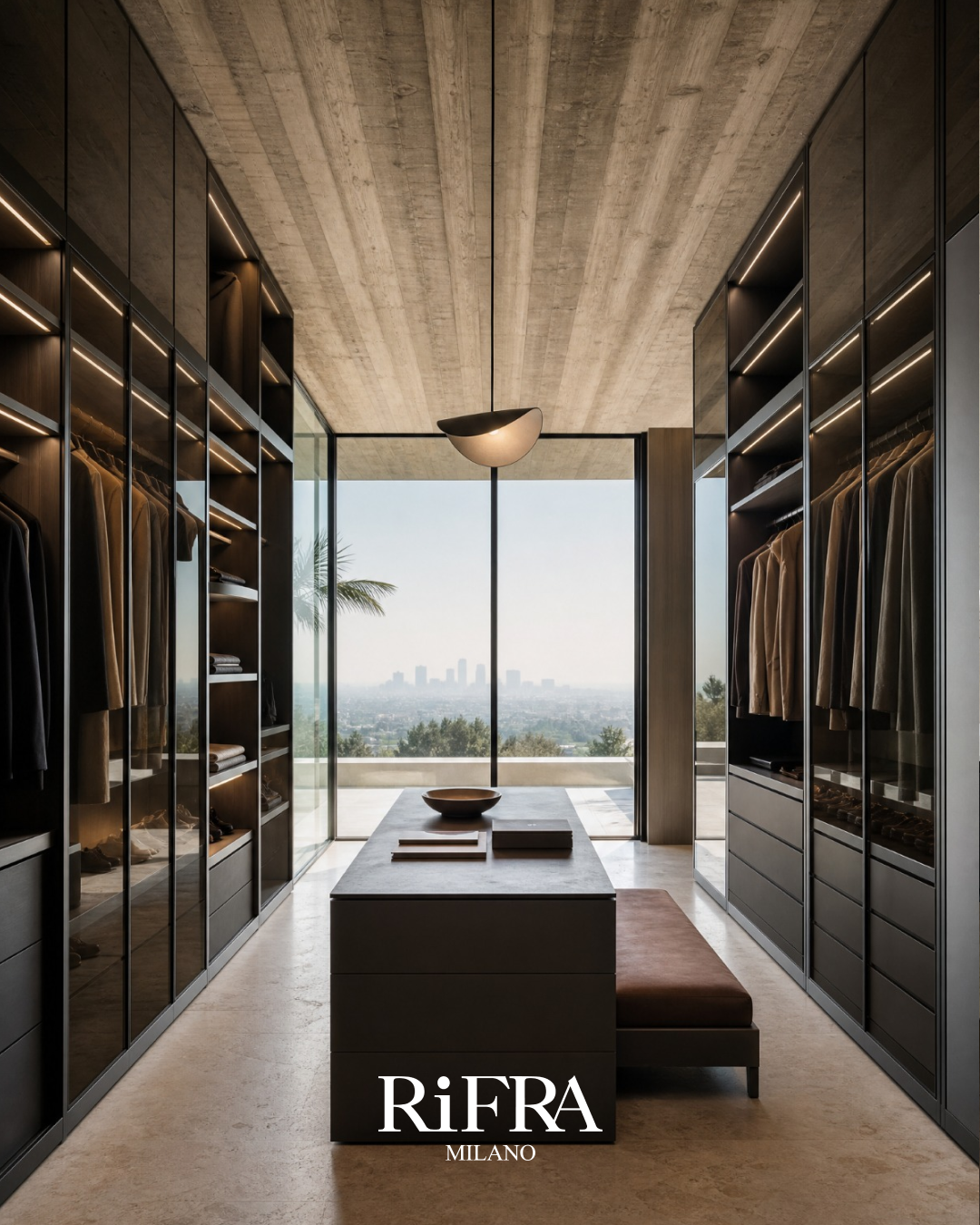
Two mirroring fronts in smoked glass and metal frame define a perfect corridor, LED strips following the height of the doors. At the centre, an island with a dark stone top and cognac leather seating. At the far end, a full-height window frames the urban horizon. The space asks for no attention: it grants it to what can be seen beyond the glass.
The bathroom: at the edge of the landscape
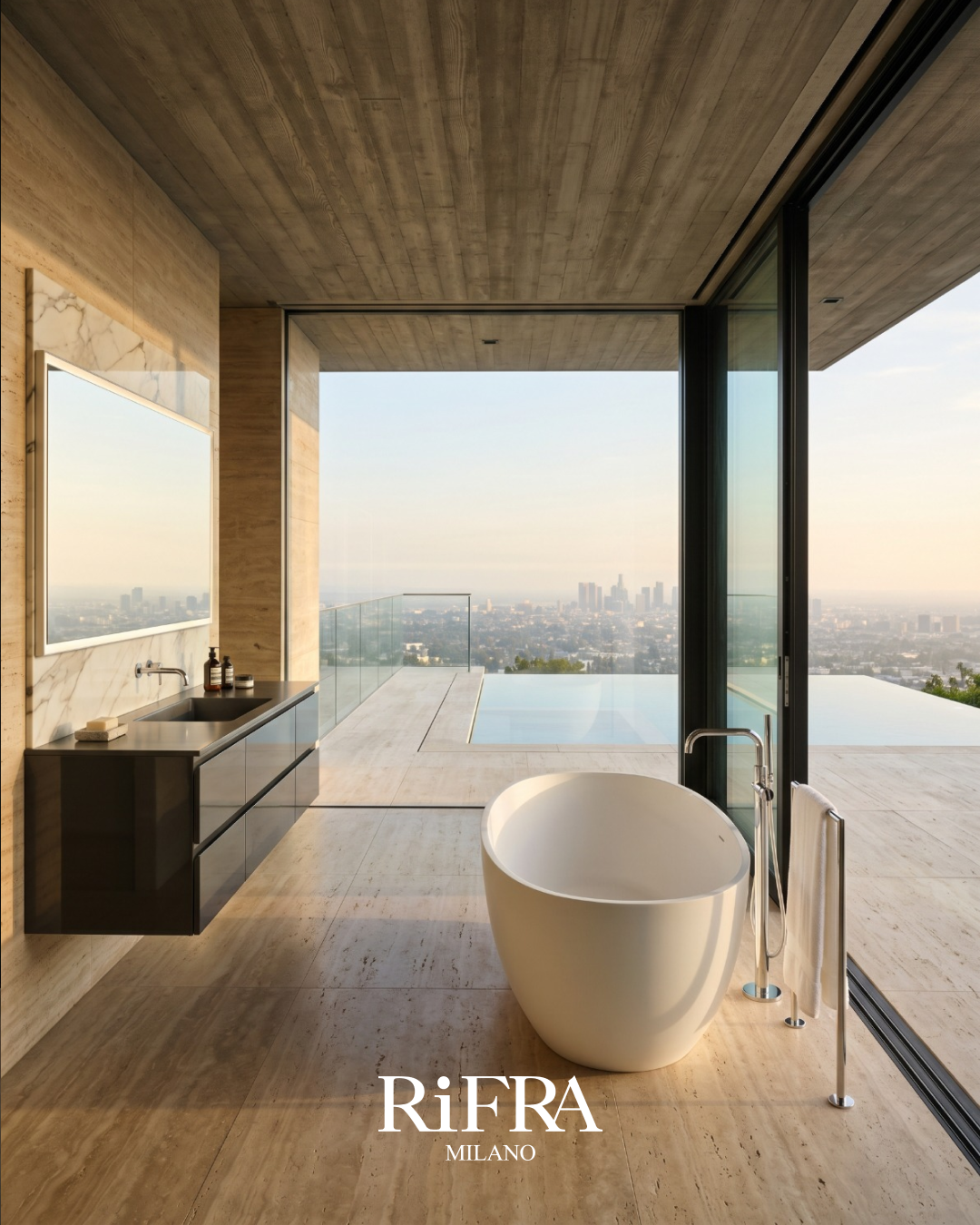
The stone continues beyond the threshold, all the way to the pool. The freestanding, monolithic bathtub sits on the edge of the glass, before the city. The glossy lacquer cabinet with a dark stone top and the marble-framed mirror hold one side of the room, while the floor-mounted taps reduce every gesture to the essential. The bathroom is imagined as a slow act, turned toward the morning light.
A material code
Natural stone, white marble, board-formed concrete, oak, cognac leather, dark velvet, brushed steel. A restrained palette, held together by a single discipline and repeated in every space with different intensities. Not materials brought together for richness, but a coherent language the project speaks from the entrance to the edge of the horizon.
Not a project with a view of the horizon. A project that makes the horizon its own measure.
Are you developing a residential or architectural project?
If you are in a phase of design or transformation, the RiFRA team is available to evaluate your project together.
👉 Request a contact