

Some projects tell their story by accumulation — of materials, of references, of gestures. Others tell it by subtraction. This villa belongs to the second family. It is a private home in Italy where the RiFRA language meets contemporary villa architecture, and where every room becomes an exercise in compositional discipline: no added decoration, no concession to visual noise. Only material, light, geometry.
Four rooms, four temperatures. The kitchen as a stage, the living room as a silent library, the walk-in wardrobe as a gallery, the master bathroom as a private spa. A route that shows how high-end Italian minimalism is not a style — it is a method.
The kitchen: a monolithic island, two materials in dialogue
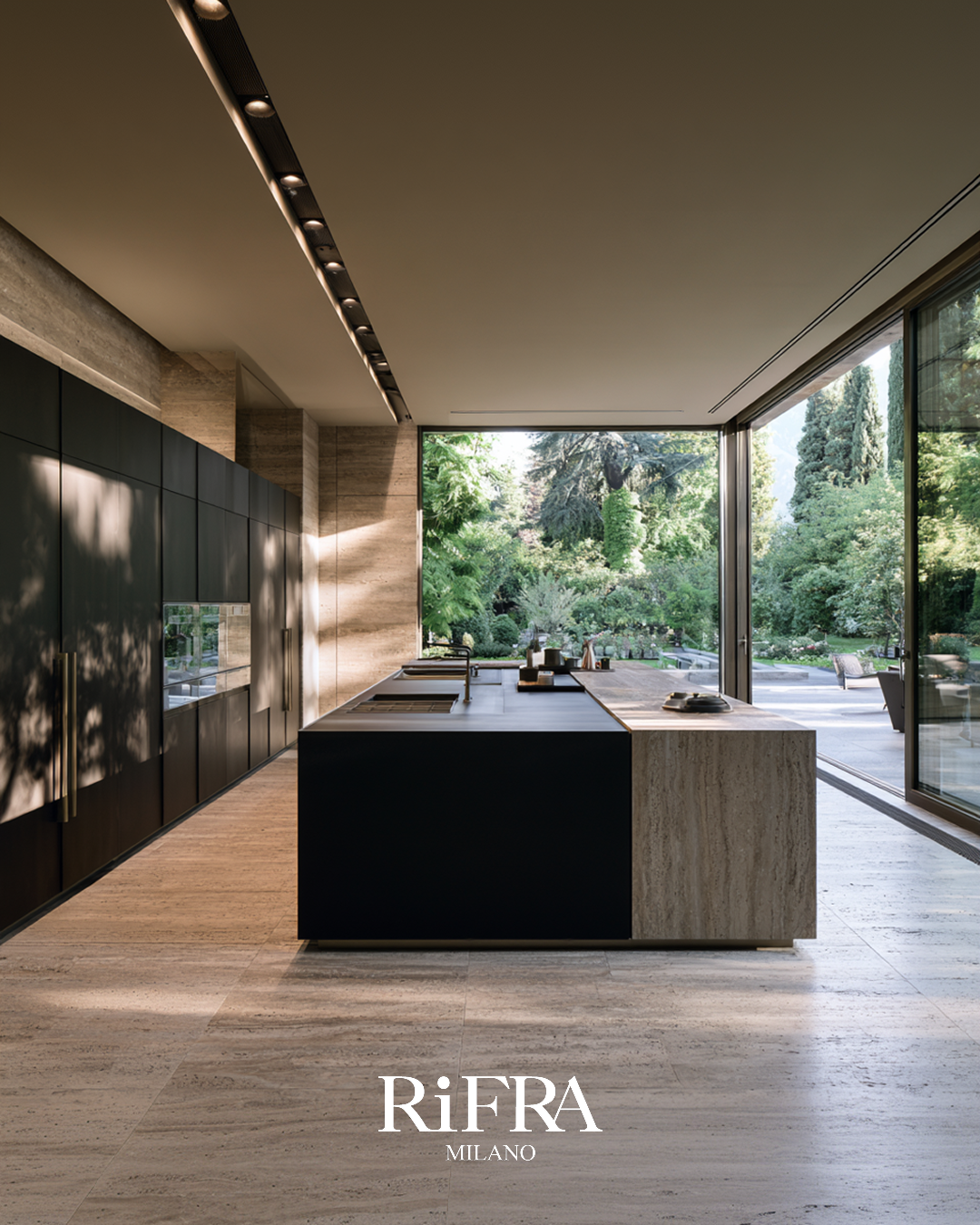
You enter through the kitchen. And it is a deliberate narrative choice, because this is where the project's statement of intent is concentrated. The large-format pale travertine flooring guides the eye toward an island suspended in space: a black volume in matte lacquer, perfectly shaped, meeting a second volume in travertine. Two materials, one architecture.
The island has no handles. It does not need them. The doors follow the pure geometry of the module, with 45° cuts that erase any technical reference and return the volume to its monolithic nature. This is the construction detail that separates declared minimalism from executed minimalism: a difference of a few millimetres, visible from across the room.
On the opposite side, the kitchen wall is organised as a technical boiserie: full-height anthracite lacquered doors, continuous development, built-in ovens integrated into the compositional grid. The bronzed handle bar — the only visible metal element — works as a horizontal accent, a line that cuts through the verticality of the doors.
The large sliding glazing opens the kitchen onto the garden. It is an architectural move with a precise weight: the kitchen is not a service room, it is one of the representative spaces of the house. When the western sun comes in, the travertine warms up, the anthracite lacquer absorbs the light, the garden becomes part of the layout.
This is the Roma mood of the RiFRA palette: travertine, warmth, Mediterranean light. An elegance that does not ask for permission.
The living room: the library as architecture
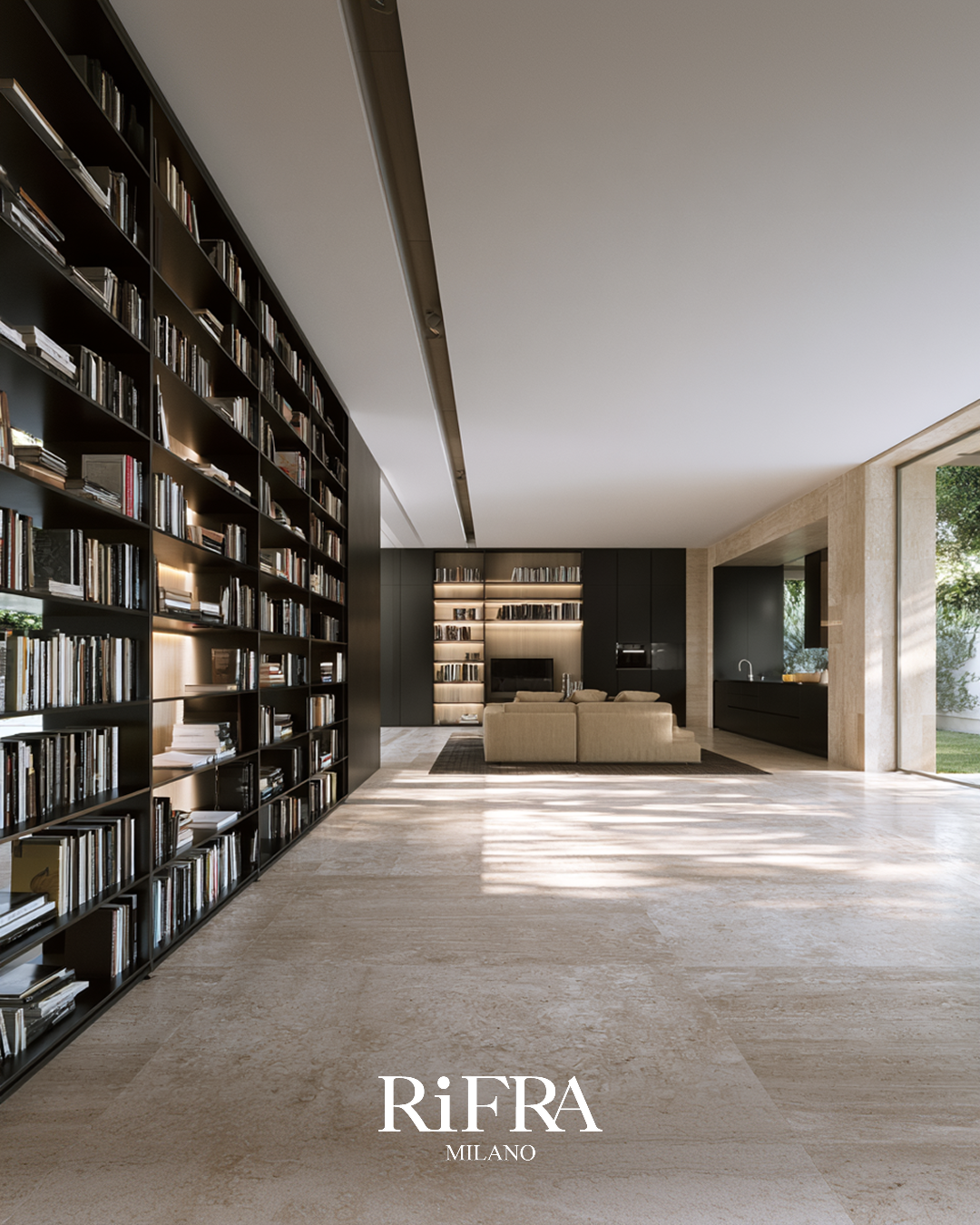
From the kitchen, you move into the living room through a calibrated opening, and the change of register is immediate. The main wall is entirely occupied by a full-height bookcase in matte black lacquer, with integrated lighting on the shelves. It is not a piece of furniture: it is architecture.
The bookcase structures the space. It defines a longitudinal axis, organises the perspective, holds hundreds of volumes without ever appearing overloaded. The secret lies in the proportions of the modules and in the reduced depth of the shelves — a solution that allows books to be displayed as objects, not as an archive. The warm light illuminating each shelf from above turns reading the spines into an almost museum-like experience.
In the background, a second, more compact bookcase wraps around the fireplace and the television, with the same compositional logic: black, illuminated wood, total integration.
The walk-in wardrobe: a private gallery
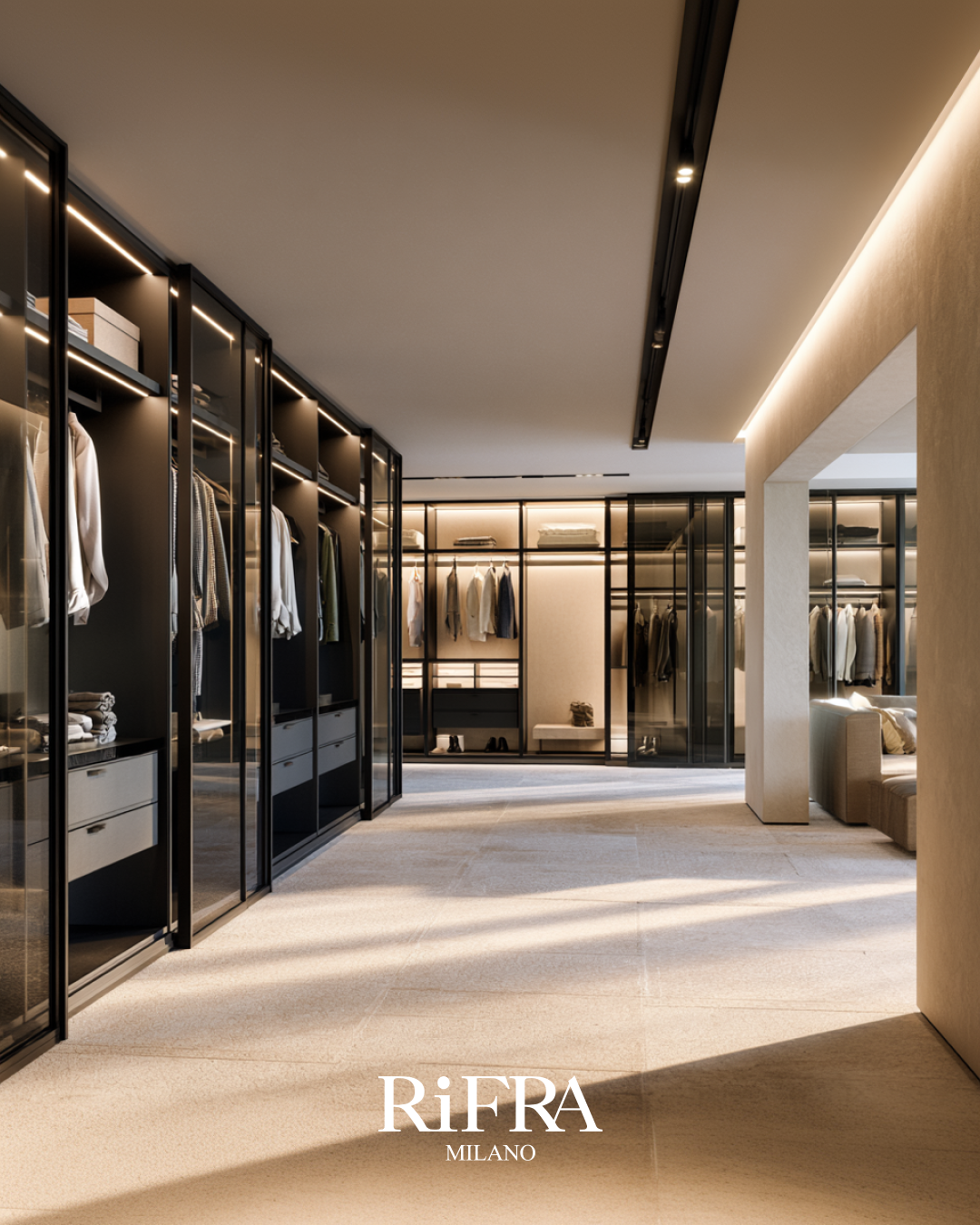
The walk-in wardrobe is the most sophisticated moment of the project. And it is a space that deserves to be rethought as a category: no longer a service room attached to the bedroom, but a true private salon, with its own architectural identity and its own narrative.
The chosen system is a modular structure with slim black metal profiles and smoked glass doors. Controlled transparency is the key: seeing the clothes, but filtered, ordered, displayed as in a high-end boutique. Each module has its own integrated lighting that activates automatically, revealing the interior with a warm, grazing light.
The details are studied with the same care as a mechanical watch. Drawers lined in light fabric, hangers in burnished metal, shelves with bevelled edges.
On the right side, a small upholstered seat in light fabric marks the transition to the sleeping area. It is a gesture that changes everything: the wardrobe is no longer a passage space, it is a room to linger in. Getting dressed becomes a ritual, not a function.
The architectural ceiling lighting — LED strips integrated into the lowered section — completes the spatial definition without ever becoming the protagonist. Everything is designed so that nothing disturbs the reading of the volumes.
The master bathroom: stone as total material
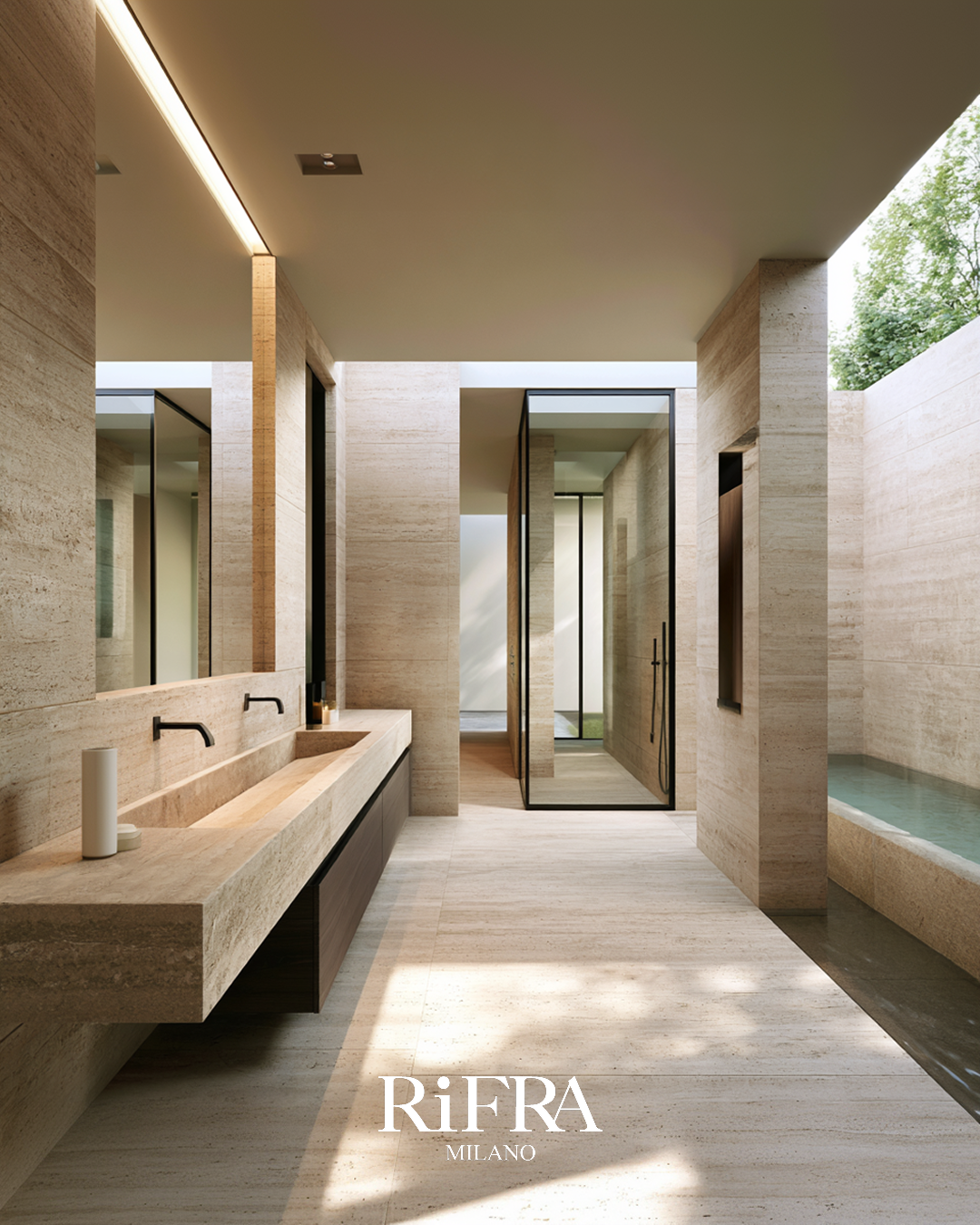
You reach the bathroom, and here the project achieves its most radical statement: a single material, declined in all its possibilities. Travertine covers the floors, the walls, the washbasin top, the bathtub. It is an exercise in material coherence that requires a firm design direction — because the temptation, in a master bathroom of these dimensions, is always to mix.
The washbasin top is a sculpted monolith: solid travertine, two integrated basins carved directly into the stone, with wall-mounted taps in matte black finish and a storage unit beneath.
This bathroom tells, better than any presentation, what "Italian minimalist luxury" means: not the absence of materials, but the concentration on one material, explored to its limit. Not the coldness of total white, but the warmth of Italian stone. Not the decorative gesture, but architecture becoming content.
The method behind the project
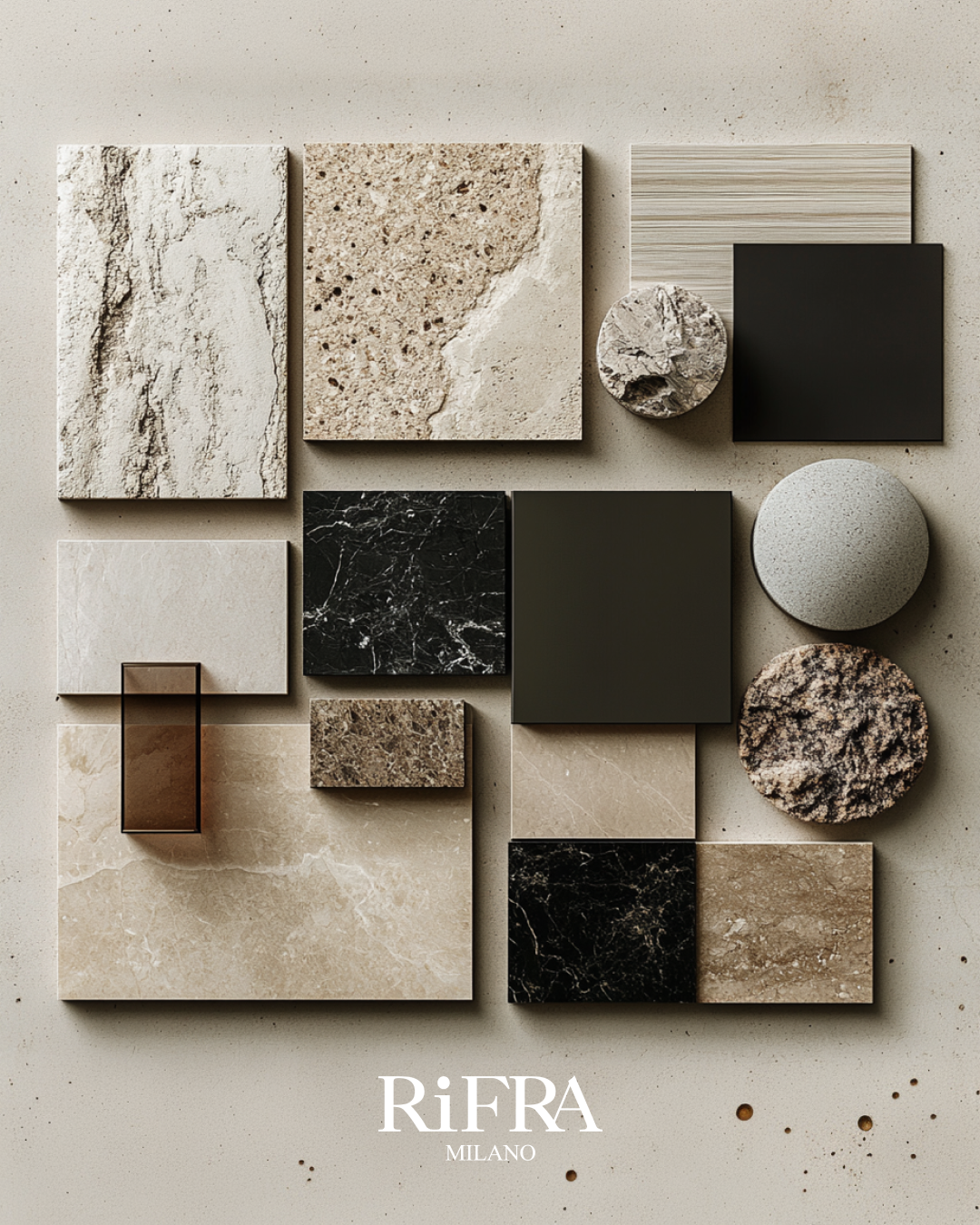
Four rooms, one single principle. The villa project works because every space is governed by a coherent grammar: a palette reduced to three or four materials per room, pure geometries with no visible handles, integrated architectural lighting, constant dialogue with the landscape.
What the visitor perceives as natural flow between spaces is in fact the result of precise design choices: the travertine in the bathroom is the same as the general flooring, the anthracite lacquer of the kitchen returns in the living room bookcase, the black frame of the wardrobe echoes that of the shower box. An underground continuity, which the lived experience does not analyse but recognises.
This is how a high-end residential project is built in Italy today. Not by adding precious elements, but by subtracting everything that is not necessary until only the essential remains — and the essential, at last, is enough.
To plan a visit to one of our showrooms and discuss your project, contact our team of designers by filling in the form at this link.
Are you developing a residential or architectural project?
If you are in a phase of design or transformation, the RiFRA team is available to evaluate your project together.
👉 Request a contact