

Some projects originate from a place.
Others originate from a question.
This project begins with a precise reflection:
what happens when the kitchen, living area, and walk-in wardrobe are not designed as separate environments, but as parts of a single architectural system?
Not a sequence of rooms.
An organism.
Domestic Architecture: Continuity First
In many contemporary homes, each space has its own autonomous identity.
Here, instead, there is only one identity.
The lines are coherent.
The proportions are calibrated in relation to one another.
Material flows through the spaces without interruption.
There is no visual break between the living and private areas.
There is rhythm.
The house does not change language — it changes intensity.
The Kitchen: Structure, Not Addition
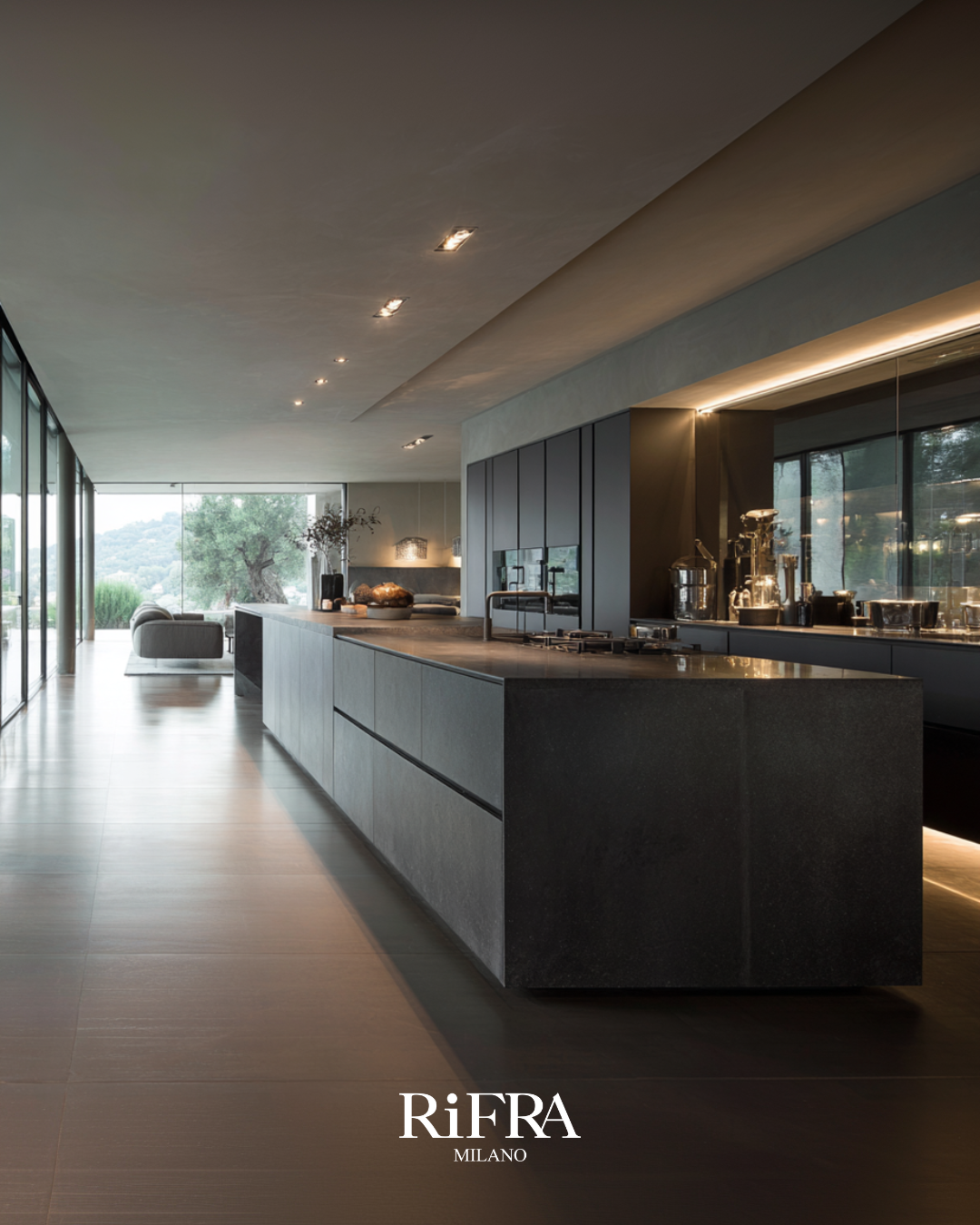
The kitchen is the starting point.
A monolithic island defines the perspectival axis.
Continuous surfaces eliminate fragmentation.
Tall units integrate into the perimeter as if they were part of the original architecture.
Technology is invisible.
Materiality takes center stage.
Stone, matte surfaces, calibrated metallic details.
Light glides across planes without theatrical effect, emphasizing volumes and depth.
Here, the kitchen is not a functional environment.
It is a structural element.
The Living Area: Evolution of the Same Language
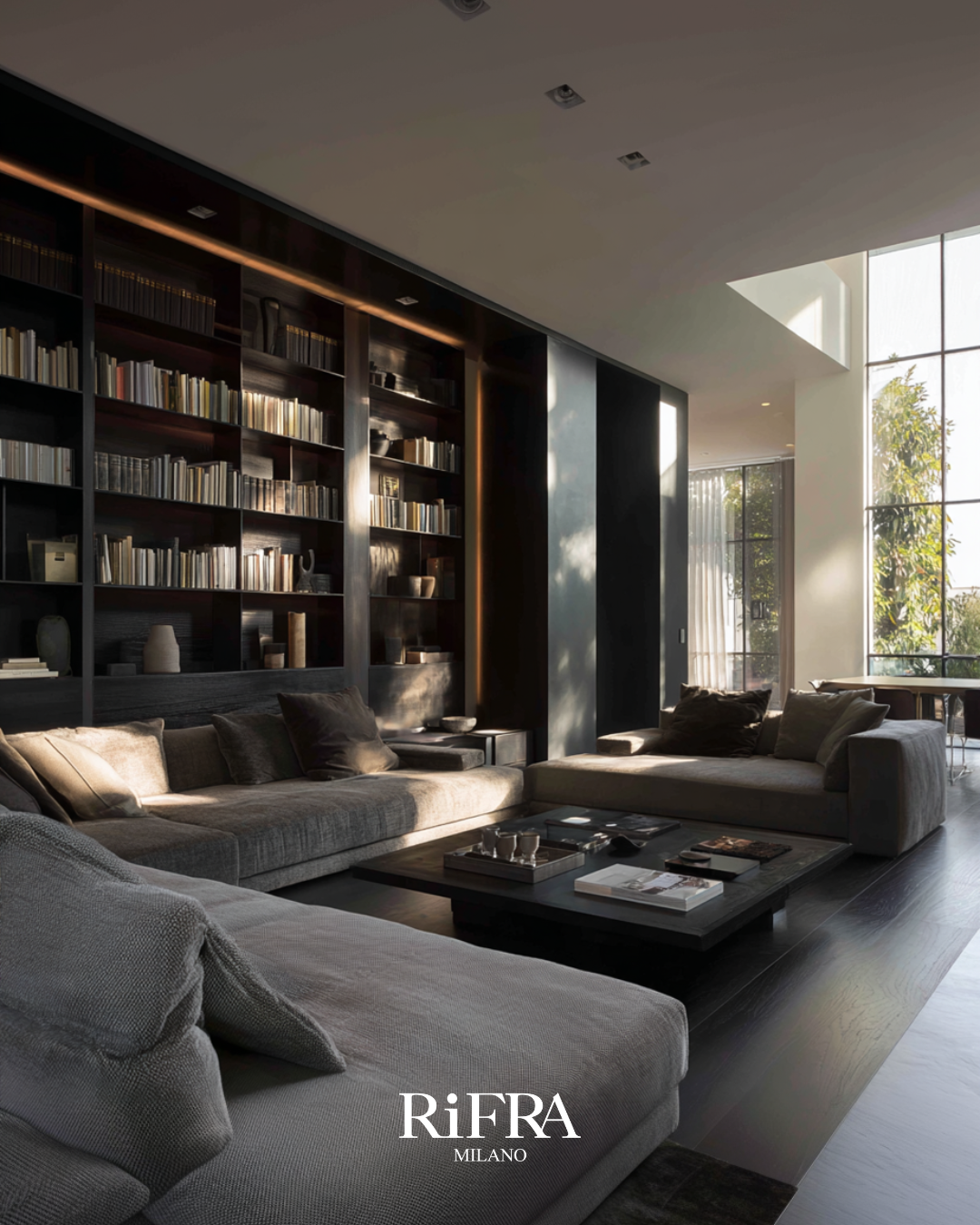
Entering the living area, nothing is interrupted.
The paneling follows the same proportions.
Bookcases dialogue with the kitchen surfaces.
Suspended volumes lighten the mass while maintaining formal coherence.
Each element is generated by the same principle:
reducing visual noise.
The result is not cold minimalism.
It is control.
When design is conceived as a system, furnishing does not rest within the space.
It completes it.
The Walk-In Wardrobe: Function Transformed into Architecture
The true test of coherence occurs in the private area.
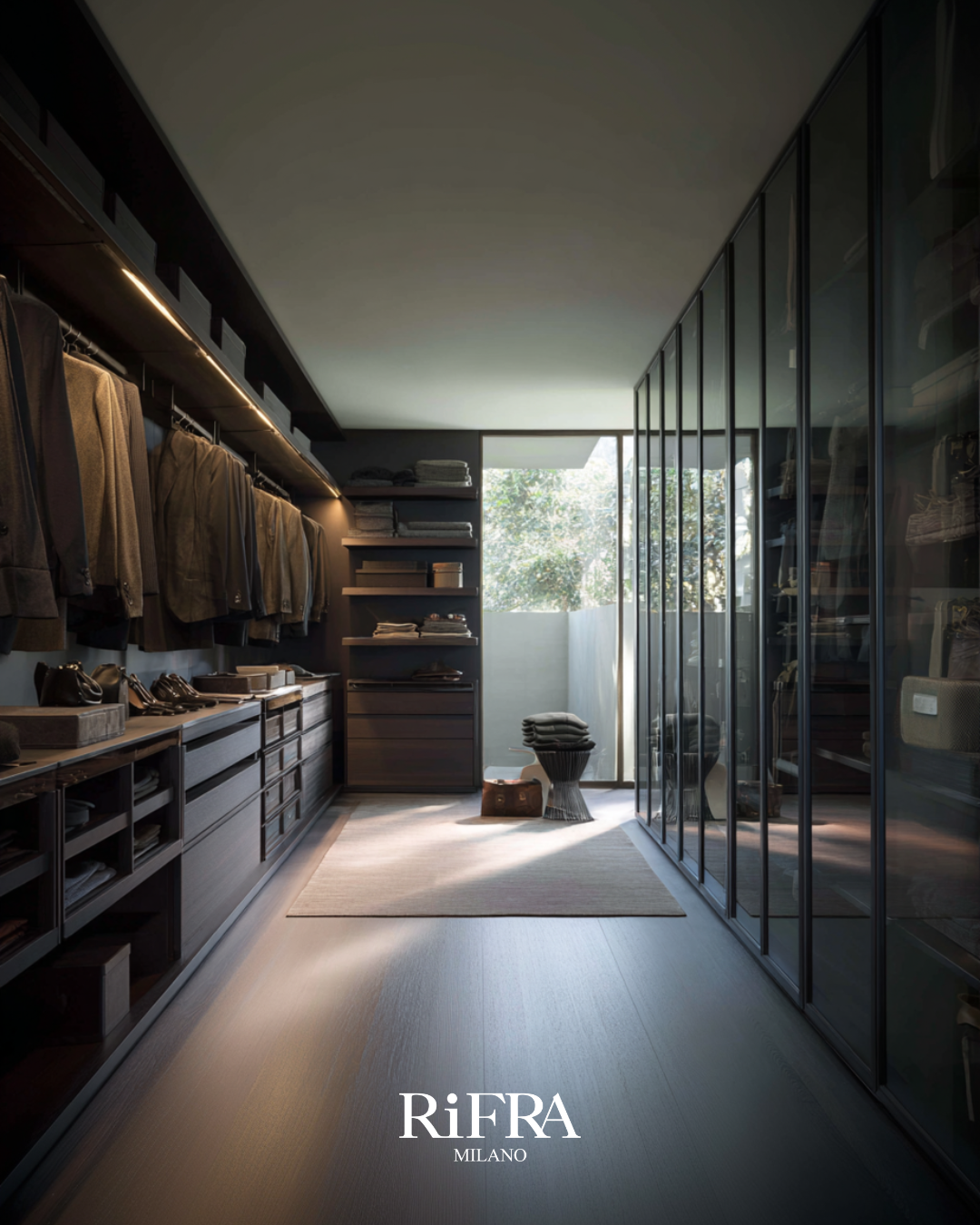
The walk-in wardrobe is not an isolated technical space.
It is the natural continuation of the project.
Full-height doors.
Integrated lighting.
Warm yet rigorous materials.
Surfaces are continuous, geometries clean, details discreet.
There is no “secondary” solution.
Each environment receives the same level of design attention.
This is where the home proves to be a coherent organism.
Designing Relationships, Not Rooms
The principle behind this project is simple:
do not design rooms,
design relationships.
Relationships between materials.
Between light and volume.
Between function and perception.
When kitchen, living area, and wardrobe are conceived together,
the home gains balance.
When conceived separately, they accumulate.
When conceived as a system, they amplify one another.
RiFRA: Integrated Architecture
Every RiFRA project is based on one conviction:
furnishing is not an object to place within space.
It is part of the architecture.
We design integrated systems that bring kitchen, living, and sleeping areas into dialogue, creating visual continuity, order, and identity.
Are you developing a residential or architectural project?
If you are in a phase of design or transformation, the RiFRA team is available to evaluate your project together.
👉 Request a contact